Good Advice
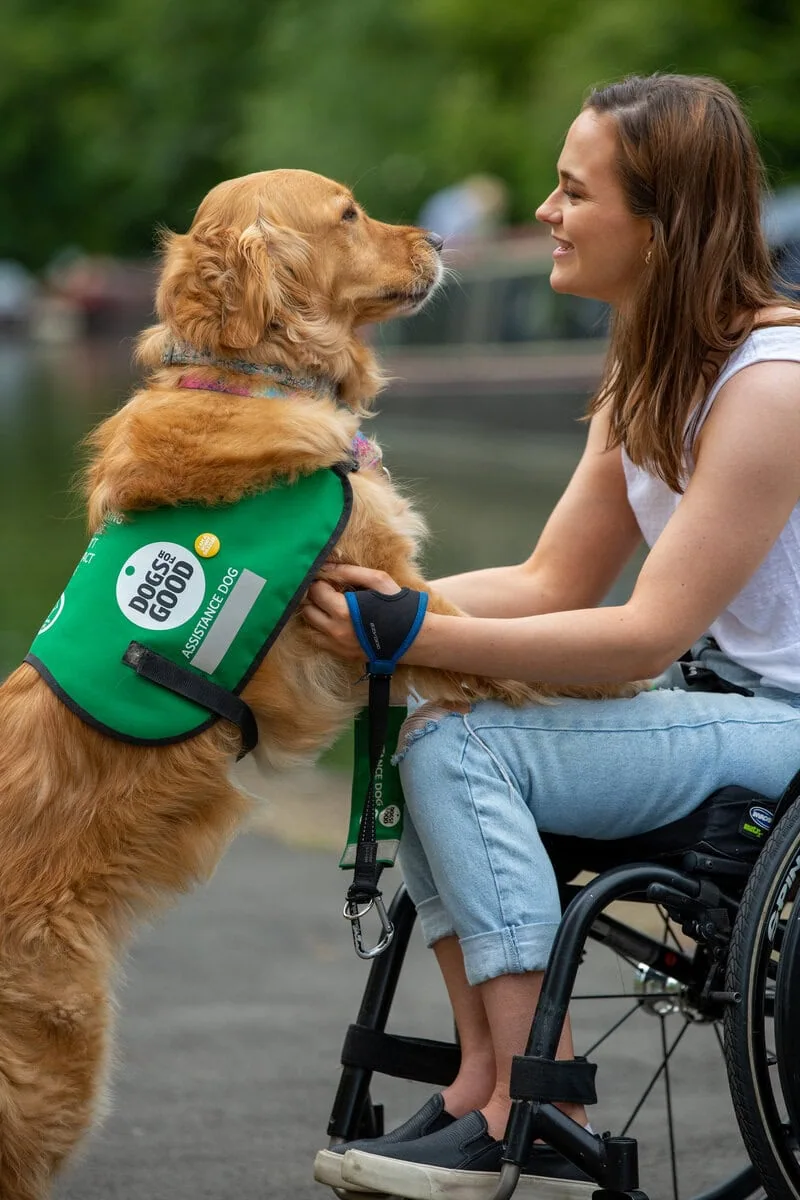
The human-dog bond is an incredibly powerful thing. Having a dog in our lives can open a door to so many positive outcomes. But what can we learn about how it works?
The health benefits of owning a dog are not only voiced in the many stories you hear from owners but also, backed up by scientific research. Some studies have shown increased mental wellbeing, better physical health, lower risks of cardiovascular disease, increased immunity to allergies in children and a reduction in social isolation… the list goes on. We have much to learn and dogs have much to teach us.
A study documenting the economic impact of pets in the UK suggests that companion animals could reduce NHS costs by nearly £2.5 billion. It’s a thought-provoking piece of work that directly examines available evidence on the direct and indirect benefits and costs of companion animals to society, including their influence on our own mental and physical health, illness prevention and well-being.
At Dogs for Good we see the phenomenal power of dogs every day through the faces of our clients; their smiles are plentiful when they’re with their dog or even just talking about their dog. And pretty much, anyone who shares their life with a dog feels the same. You can read more in our article about the human-dog bond and why it’s so important.
Dr Carri Westgarth, is Senior Lecturer in Human-Animal Interaction at the University of Liverpool, author of ‘The Happy Dog Owner’ and has a passion for understanding the relationships we have with our pets. “There is a biological basis for the bond we feel with our dogs and also the health benefits that come from that relationship,” she says. “A hormone called Oxytocin, often called ‘the love hormone’, gives us the rush of love and tug on the heart strings we feel when we look at our dogs. Interestingly, some research suggests our dogs also get that Oxytocin rush, confirming that the love between us and our dogs is a two-way street.”
Beautiful, isn’t it?
Our Community Dog Team have put together a mini virtual therapy session bringing you face-to-face with our dogs to give you a little Oxytocin boost!
Why are dogs so good for our physical health?
Dr Westgarth conducted a study in the UK around dog ownership and physical activity and found that dog owners walked their dogs, on average, seven times a week, totalling 220 minutes of exercise. This exercise was in addition to taking time to do other activities such as going to the gym or running etc. Clearly, dogs are powerful motivators! “In a different study, Interview participants tell me that walking their dog doesn’t feel like exercise,” says Carri. “One person even coined it ‘exercise by stealth’!” In addition, this study revealed that dog owners take time to walk their dogs because it clearly makes their dog happy… and that makes them happy. “The more we see how happy our dogs are, the more we bond with them. The more we bond with them, the more we want to make them happy,” says Dr Westgarth.
Dogs help us with our mental wellbeing
The mental health benefits of having dogs in our lives are also significant. We hear this from the partnerships we create between our clients and assistance dogs and also from the many volunteers that help us in our work by socialising our puppies and boarding our dogs in training.
Dogs for Good success stories
Allison is partnered with Dogs for Good assistance dog, Luna and has a spinal injury which saps her energy. Before being matched with Luna, Allison used to spend days, sometimes weeks, in bed and unsurprisingly, this took a huge toll on her mental wellness. Everything changed with the arrival of Luna. “She’s brought my confidence out of its hiding place and from spending days indoors in my pyjamas, I’m now planning days out for the pair of us,” says Allison. “We go out every day, I’ve met so many new friends and best of all, she makes me laugh every day.”
Retired engineer, Gerry Bernardo, is one of Dogs for Good’s many fabulous volunteer temporary boarders and, for more than ten years, has looked after over 50 of our clever dogs! Gerry says that volunteering for Dogs for Good helped him to cope with the grief of losing his wife to Alzheimer’s disease and living alone through the pandemic. “Losing Heather, my wife, was very difficult. It was a really bad time for me emotionally. But the dogs don’t have any views on things like that. They are always the same, so it is great to have them, and they really help me. I don’t think I could cope without a dog,” he says.
Dogs can help reduce our stress levels
Dogs can also be hugely effective at reducing stress levels. In 2016, a study conducted by Dogs for Good and the University of Lincoln, researched whether dogs could have an impact on families with a child with autism and the results were powerful and positive. As a result of their pet dog being in their lives, the families that Dogs for Good worked with experienced significantly lowered parental stress, were able to go out more together as a family, and autistic children experienced fewer meltdowns.
“One of the most interesting studies I’ve seen is an experimental study looking at our responses to stress when we have our dogs with us,” says Dr Westgarth. The test was an arithmetic test or immersing a hand in cold water, and people’s stress responses were measured by heart rates. People were asked to carry out the tests under different conditions that were randomly assigned; one condition was carrying out the test on their own, which proved quite stressful. “Others were asked to do the test with their dog in the room and their stress levels were much lower. Another group took the test with their spouse in the room and a group of people who didn’t own a dog, with their closest friend instead … both conditions resulted in higher stress levels. These results are really interesting to me because it echoes what I’ve found in other studies; that the relationship that people have with their dogs isn’t at all the same as they have with humans. It simply can’t be substituted. Yes, our closest friend or spouse will give us emotional support and social connections but the relationship we have as humans with our dogs is unique.”
Dogs help us feel less lonely
Loneliness and social isolation are felt by many. But, research shows that dogs can be the ‘glue’ in a community; a way of bringing people together and keeping people interested in what’s going on around them. At Dogs for Good, we applaud the development of any community-based initiatives that encourages people and dogs to come together as a way of tackling social isolation.
Dr Westgarth says that people who have dogs in their lives are shown to have much greater ‘social capital’ in their communities than people who don’t. “Social connections in communities are really important for us as humans,” she says. “On a really basic level, it’s far more likely that people will stop and chat to someone who has a dog than those who don’t.”
It’s clear that dogs can play a huge role in increasing our health and wellbeing and this means that every dog owner has a potential ‘natural health service’ living with them.
Even better, our work at Dogs for Good shows that the more we support the wellbeing of dogs, the more they thrive. It’s really important for us all to remember that as much as dogs are good for us, we need to make sure we’re good to them, too.
Help support our life-changing work...
Imagine if everyday tasks were so challenging or physically demanding they affected your quality of life. For many people living with a disability or families with a child with autism, that is their reality. Now imagine if a specially trained four-legged friend could restore your, or your family’s, independence.
The demand for our services is high and we can’t help as many people as we would like to without more funding. Please help us continue to bring people and dogs together to help make everyday life possible in so many extraordinary ways.
Every contribution, whatever size, is important and helps us make a difference.
